If you’re not in the fence business, you probably don’t spend too much time thinking about fence materials, and some get even less attention than others.
Razor wire is a less commonly used product, which might explain why some people think it’s the same thing as barbed wire. However, they’re not. Here’s what the difference between razor wire and barbed wire is, what each one is used for, and how to make sure you get the right one for your project.
What Is Razor Wire?
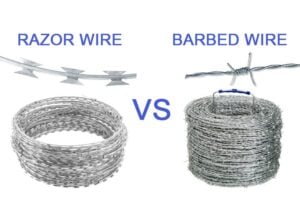
Razor wire is a high-security fence product made by wrapping a pre-cut razor strip around a central core wire. The strip does not completely encircle the wire but forms “blades” that stand at right angles to the core. Razor wire comes in various configurations—short barb, medium barb, and long barb—and those strands can be used to create other razor wire products, such as BTC coils, flat wrap razor wire, or razor mesh.
It can be made from galvanized steel or stainless steel, or sometimes a combination of both. Because of the continuous metal strip, razor wire tends to be stronger and more rigid than traditional wire products, making it more resistant to bending or cutting. In high-security applications, such as prisons, military bases, or certain industrial sites around Phoenix, razor wire is a common choice for added perimeter defense.
What Is Barbed Wire?
Barbed wire is created by wrapping a separate wire around one or two central wires at regular intervals—usually every 4 to 6 inches—to form barbs. These barbs can be single (with only two points) or double (with four points). Unlike razor wire, barbed wire doesn’t derive added stiffness from a continuous metal strip; instead, it relies on the sharp barbs.
Barbed wire is typically easier to install and mold to different fence designs because it’s more malleable. It’s available in galvanized and PVC-coated finishes, making it suitable for many environments, including Arizona’s desert climate. Barbed wire is widely used for agricultural fencing, especially in rural parts of the state where livestock management is common.
What Is the Difference Between Barbed Wire and Razor Wire
Although both types of wire serve to deter unauthorized entry, they differ greatly in composition and appearance. Barbed wire has individual barbs twisted around the core, while razor wire features a continuous metal strip wrapped around the core, forming blade-like edges.
Razor wire’s design makes it more rigid and generally more dangerous to handle or cross. Barbed wire, on the other hand, is more pliable and simpler to install. When observing them up close, the distinction between barbed wire’s twisted barbs and razor wire’s pre-formed blades is very clear.
What Are Barbed Wire and Razor Wire Usually Used for?
Barbed wire is commonly associated with farmland and livestock control, though it can also be used on top of commercial fences for a modest security boost. Razor wire, given its sharper blades and higher rigidity, is almost always found in high-security settings. In some situations, barbed wire is affixed to fence-top extensions, and razor coils are then secured to the barbed wire, combining both products for enhanced protection.
Is Barbed Wire or Razor Wire Cheaper?
Barbed wire is typically less expensive because it’s easier to manufacture and generally uses less raw material per foot. This cost difference makes barbed wire a popular choice for large-scale agricultural projects or for property owners on a tighter budget. Razor wire, while more expensive, serves a crucial need if high security is a priority.
How Is Barbed Wire and Razor Wire Sold?
Barbed wire is usually sold in large spools, with many containing over a thousand feet of wire. Razor wire is sold in several forms depending on the product type. Unclipped razor wire may come in rolls, while BTC or razor coils are sold in pre-formed coils with a defined maximum expansion. Razor mesh, another high-security option, is often sold in sheets measuring around 6 meters (about 20 feet) in width.
Do You Need Barbed Wire or Razor Wire?
Razor wire tends to be reserved for projects needing substantial perimeter defense, from high-risk commercial sites to sensitive government locations. In many regions, including some municipalities around Phoenix, you may need to check local codes or obtain special permission before installing razor wire. For most agricultural and everyday commercial uses, barbed wire is typically sufficient and more cost-effective.
If your project demands extra security or you’re unsure which product suits your needs, consider getting professional advice. Local laws can vary, and you want to ensure your fence meets both your security requirements and local regulations.
Western Fence has been serving the Phoenix area for decades, providing commercial and industrial fence solutions for operations of all sizes, including projects that require barbed wire or razor wire. If you’re looking for reliable fence installation and assistance in choosing the right fencing for your property, learn more about our Phoenix fence installation services.